
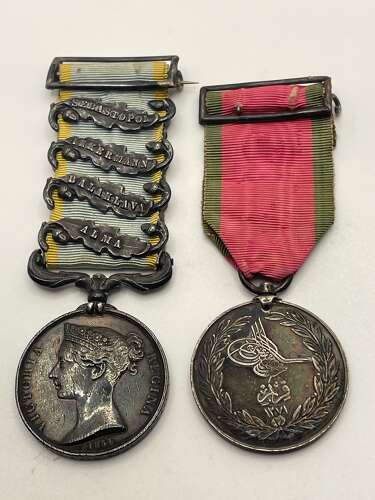


Queen’s Crimea Medal & Turkish Crimea GRENADIER GUARDS
Code: 11620
Queen’s Crimea Medal 1854-56. 4 x Clasp: Alma, Balaklava, Inkerman, Sebastopol. Engraved Naming. Old Silver toned Medal. Mounted on top Bar with rear Pin assembly.
Turkish Crimea Medal 1855. BRITISH ISSUE, unamed as issued, old Silver toned medal. Mounted on top Bar with rear pin assembly.
6660. Sergeant. G. Fox. 3rd Bn Grenadier Guards.
George Fox enlisted 19th June 1846 in Swindon, Wiltshire. Trade Labourer, aged 23 years old in the 3rd Bn GRENADIER GUARDS, height 6ft 4 ins. He Served over 9 Years at home, before serving in the CRIMEA. Promoted Corporal on 13th July 1837, served in the CRIMEA for 312 Days, during which time was promoted to SERGEANT 8th July 1854
On 24th November 1856 on return to England, at the age of 33 years he requested to terminate his service with the Colours. Having served 10 Years & 150 Days in the GREADIER GUARDS.
3rd Bn Grenadier Guards.
The original strength and subsequent drafts made a total of 2,500 Officers and Men who fought in the Crimea. Exactly half this number became Casualties in one way or another, 180 men were killed in action, while some 800 died of disease including many of the wounded due to poor medical care and severe frostbite. This was due to the men having no warm clothing and fought in Bearskins and red tunics that were not suitable for the conditions encountered.
During the seige of Sebastopol the 3rd Bn Grenadier Guards had many men die from diseases like Typhus, Typhoid, Cholera, and Dysentery. The weather conditions were horrendous temperatures well under freezing to a point where wet tunics snapped in the cold.
Scutari Barracks Hospital in Constantinople was a battlefield of disease and neglect during the Crimean War. Despite initial efforts by Florence Nightingale and her team of nurses the rising death rate in early Febuary 1855 was rising to 48%. It took many months to improve the dire conditions marked by overcrowding, poor hygiene, starvation, and lack of supplies.
The Hospital was built on a damaged sewer that flooded and contaminated drinking water leading to outbreaks of Cholera, dysentery, and typhoid fever. More Solders died of preventable diseases than their actual battle wounds.
The Crimea War had been a grim and ill-managed War, the Army as a whole was disgracefully rusty and mismanaged after 40years of peace since Waterloo. Organisation and equipment was hopelessly inadequate, the Commanders were old and out-of-date, and it is always the SOLDIERS on the sharp end who suffer the consequences. Collaboration with our FRENCH ALLIES after 700 years of fighting them had proved to be decidedly difficult compounding the problems.
